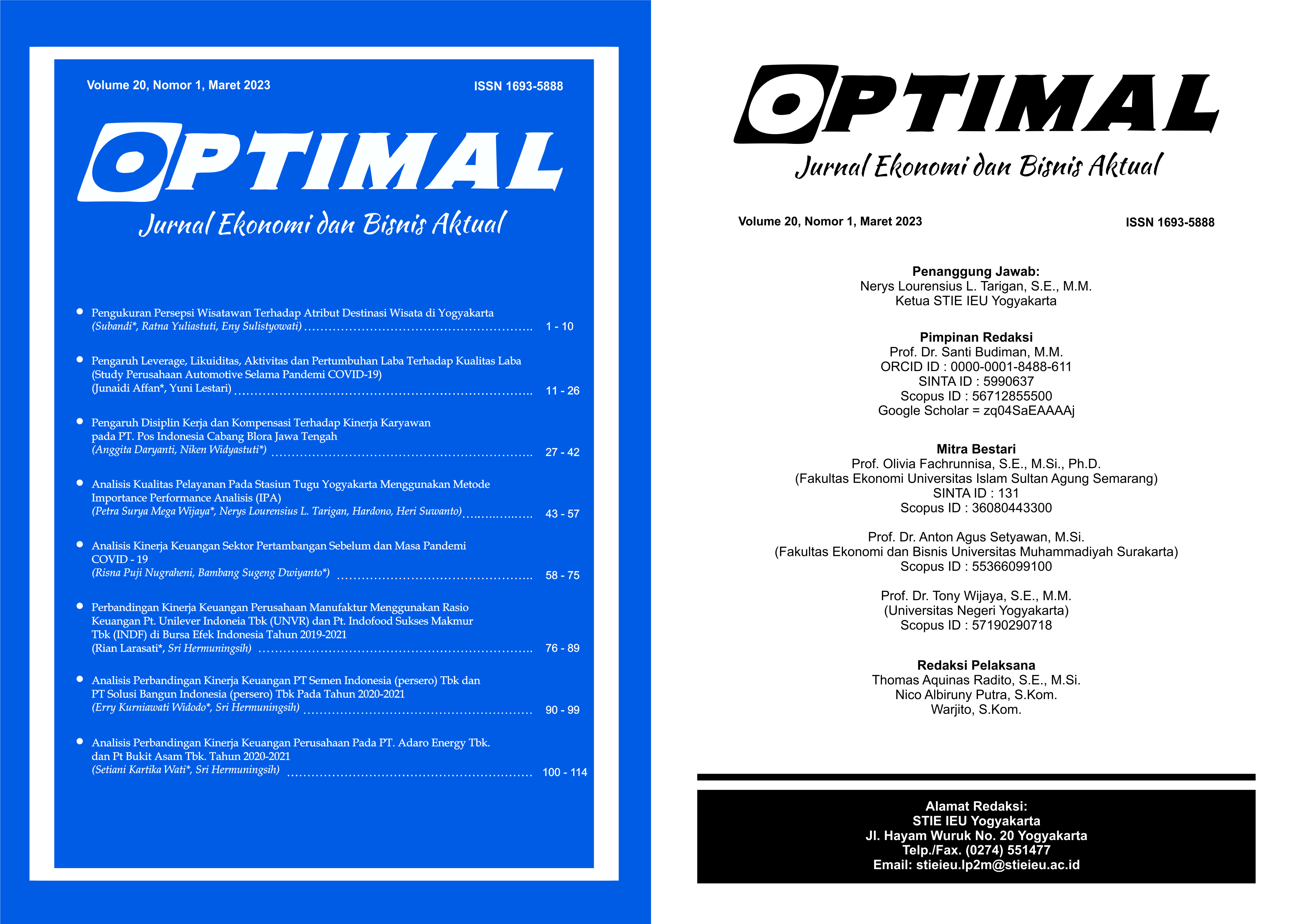
PENGARUH DISIPLIN KERJA DAN KOMPENSASI TERHADAP KINERJA KARYAWAN PADA PT. POS INDONESIA CABANG BLORA JAWA TENGAH
Abstract
This study aims to determine the effect of work discipline and compensation on employee performance. The data used in
this study are primary data obtained from questionnaires. The number of samples is 61 respondents which is the entire
population of employees of PT. Pos Indonesia (Persero) Blora Branch, so a saturated sample is used. The type of research
used is a quantitative approach. The data collection methods used in this study used observation, questionnaires, and
documentation where the respondent's interpretation data was then regulated using data analysis techniques in this case
SPSS. Based on the results of the research data analysis, the regression equation Y = 8.958 + 0.508X1 + 0.003X2. The
results of the t test show that the work discipline variable has a probability value of 0.089 > 0.05, which means that the
work discipline variable has no significant positive effect on employee performance variables and the compensation
variable has a probability value of 0.993 > 0.05, which means that the compensation variable has no significant positive
effect on employee performance variables, and the proposed hypothesis is declared "rejected". The results of the f test show
that the work discipline variable and compensation variable have a probability value of 0.000 <0.05, which means that
the work discipline variable and compensation variable have a significant positive effect on employee performance
variables, and the proposed hypothesis is declared "accepted".
Keywords: Work Discipline, Compensation, and Employee Performance.
Downloads